

Chef’s Overview
Dear Chefs, when vegetables start piling up and speed matters, blade choice becomes the difference between smooth prep and sloppy momentum. Santoku and Nakiri knives both promise fast, efficient vegetable work, but they go about it in very different ways. Today we’re breaking down Santoku vs Nakiri, what’s best for fast vegetable prep, and how to choose the blade that actually keeps you moving.

When the Cutting Board Turns into a Race Clock
Dear Chefs, there’s a moment in every kitchen when the vegetables outnumber your patience. Carrots rolling, onions multiplying, herbs waiting their turn. That’s when you learn whether your knife is helping or slowing you down. I’ve had prep sessions where the blade felt like it was keeping time for me, and others where every cut felt like resistance. It echoes what we talked about in Why Knives Matter – More Than Just Tools in the Kitchen, the right knife doesn’t just cut food, it protects your rhythm. Santoku and Nakiri both step up here, but they do it with very different personalities.
How Santoku and Nakiri Knives Are Designed for Vegetables
At first glance, Santoku and Nakiri knives look similar, flat profiles, wide blades, and a focus on vegetables. But the intent behind each design changes how fast and comfortable prep actually feels. We touched on this contrast in From Bunka to Nakiri, Why Every Pro Chefly Knife Has a Place in Your Kitchen, but vegetable-heavy cooking makes the differences impossible to ignore.
Santoku Knife Design and Vegetable Speed
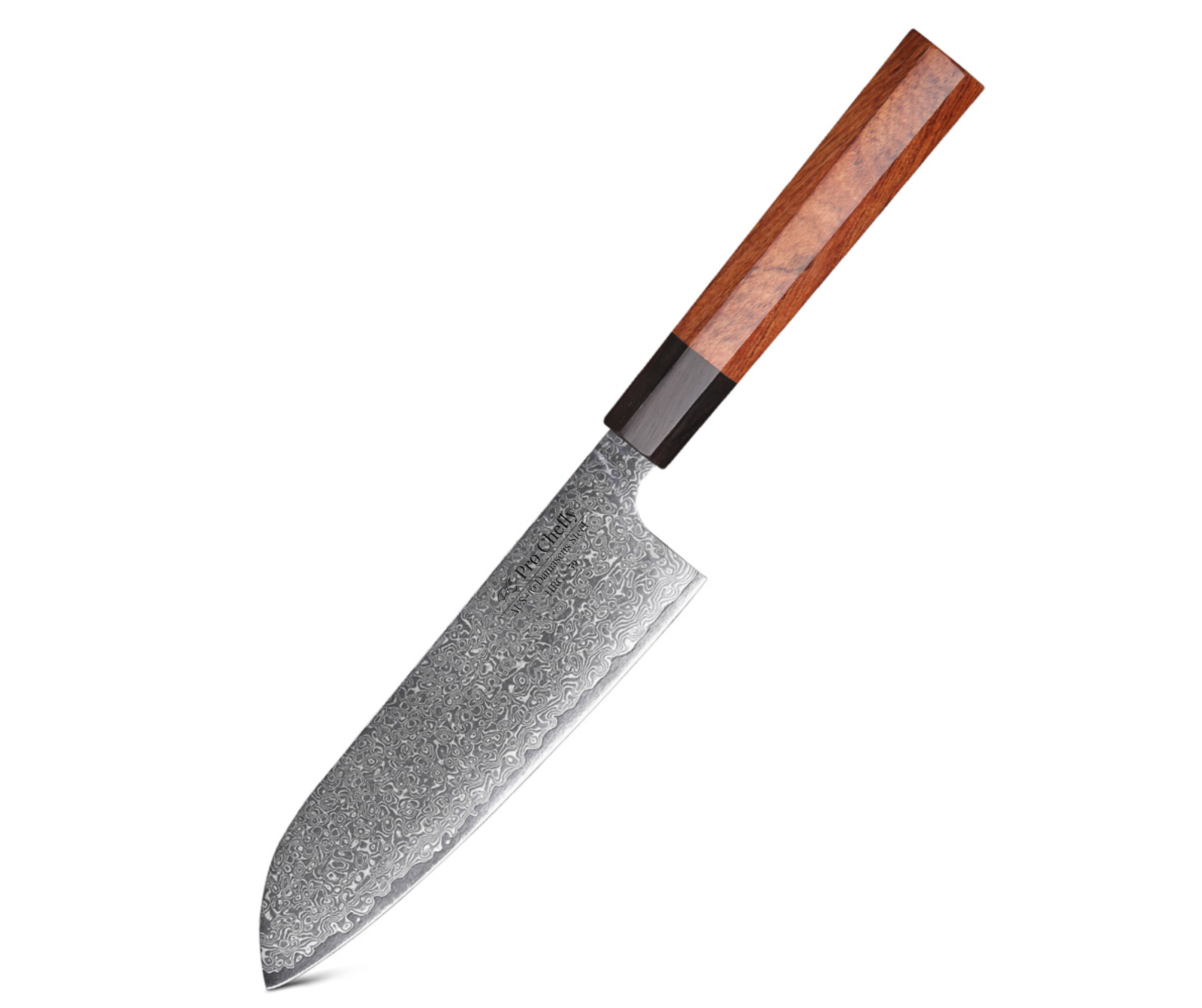
The Santoku was built for versatility. Its slightly curved edge allows for gentle rocking while still handling push cuts cleanly. The blade height gives knuckle clearance, and the rounded tip keeps movement fluid. Our 7" VG-10 Damascus Santoku Knife thrives when vegetable prep is mixed with other tasks, slicing peppers, chopping herbs, then jumping straight into protein trimming. That flexibility keeps you fast because you don’t have to think about switching tools.
Nakiri Knife Design and Straight-Line Efficiency
The Nakiri is unapologetically focused. Its completely flat edge is designed for straight up-and-down chopping. No rocking, no tip work, just clean, repeatable cuts. The blade stays in constant contact with the board, which makes vegetable prep incredibly efficient. The 7" VG-10 Damascus Nakiri Knife excels when speed comes from repetition, cabbage, carrots, squash, and anything that benefits from uniform slices. This is the knife that turns large vegetable prep into muscle memory.
Speed Isn’t Just About the Blade, It’s About Motion
Fast vegetable work isn’t about cutting faster, it’s about cutting smarter. The motion each knife encourages directly impacts fatigue and accuracy.
Santoku Speed Through Flow
Santoku knives keep speed through flow. The slight curve allows you to move seamlessly from ingredient to ingredient without changing technique. That matters in home kitchens where prep tasks change constantly. This versatility mirrors what we discussed in How a Santoku Knife Handles Daily Prep Work, the Santoku keeps momentum by staying adaptable.
Nakiri Speed Through Consistency
Nakiri knives build speed through consistency. Every cut looks like the last. There’s no wasted motion, and no need to reset your hand position. If you’ve ever done a full prep of root vegetables or greens, you’ve felt how powerful that consistency becomes. It’s the same advantage highlighted in Why Nakiri Knives Create the Most Even Vegetable Cuts, uniform motion leads to uniform results, faster than you expect.
How Steel Choice Impacts Fast Vegetable Prep
Vegetable work exposes steel quality immediately. A dull edge wedges, sticks, and slows everything down. VG-10 Damascus steel changes that experience entirely. The edge stays sharp longer, glides through dense produce, and releases food more cleanly. Whether it’s the Santoku or Nakiri, VG-10 Damascus steel keeps speed sustainable, not just impressive for the first few cuts. This ties directly into what we covered in How VG-10 Steel Balances Edge Retention and Durability, sharpness that lasts is what keeps prep fast over time.
How Pro Chefly Chooses Between Santoku and Nakiri
At Pro Chefly, we don’t ask which knife is better, we ask where it belongs. The 7" VG-10 Damascus Santoku Knife is for chefs who want speed without specialization, one blade that adapts as fast as the menu changes. The 7" VG-10 Damascus Nakiri Knife is for cooks who live in vegetables and want maximum efficiency with minimal effort. Both reflect what we laid out in Our Philosophy – Sharpness, Honesty, and Craftsmanship, every knife should earn its place through purpose, not hype.
Speed Lives Where Comfort Meets Confidence
Dear Chefs, when it comes to fast vegetable work, the best knife is the one that disappears in your hand. Santoku wins when speed comes from versatility and flow. Nakiri wins when speed comes from repetition and precision. Think of the Santoku as a skilled multitasker and the Nakiri as a focused specialist. Once you understand how each moves, speed stops being something you chase and starts being something you feel.
Knife Collections
Shop the latest in Pro Chefly Damascus Knives





Chef's Notes
Stay up to date with the latest kitchen stories and recipes

- March 25, 2026
Dear Chefs, this is one of those dishes that feels like it belongs next to the ocean, even if you’re...

- March 23, 2026
Dear Chefs, this is the kind of spring dish that wakes up your entire kitchen the moment it hits the...

- March 19, 2026
Dear Chefs, some dinners don’t whisper, they walk into the kitchen with confidence and a little swagger. Surf and Turf...

- March 17, 2026
Dear Chefs, there’s something satisfying about a dish that feels wholesome, bright, and quietly comforting all at the same time....

- March 13, 2026
Dear Chefs, there is something about cooking whole fish that feels both elegant and surprisingly simple once you understand the...

- March 11, 2026
Dear Chefs, spring cooking always pulls me toward dishes that feel light, bright, and quietly luxurious without trying too hard....
- Choosing a selection results in a full page refresh.
- Opens in a new window.