

Chef’s Overview
Dear Chefs, small knives decide whether prep feels graceful or clumsy, and that choice shows up faster than any big blade debate. Petty and paring knives look similar until the work starts, then their differences become impossible to ignore. Today we’re breaking down which everyday tasks clearly favor a Petty knife and which belong to a paring knife, without mythology or overlap. By the end, you’ll know exactly which blade earns counter space and which one stays in the drawer until it’s truly needed.

Small Tasks Expose Big Differences in Knife Design
Tiny jobs don’t tolerate inefficiency. When trimming strawberries or peeling garlic, even a slight mismatch between blade and task turns into frustration. That’s why the Petty versus paring conversation matters more than people expect. Petty knives were designed for controlled board work at smaller scale, while paring knives were built for hand-held precision. We explored this philosophical split before in What Is the Real Difference Between Petty and Paring Knives, and the takeaway remains consistent, these knives aren’t interchangeable, they’re complementary. Once you assign them correctly, prep stops feeling like compromise.
When Petty Knives Clearly Win
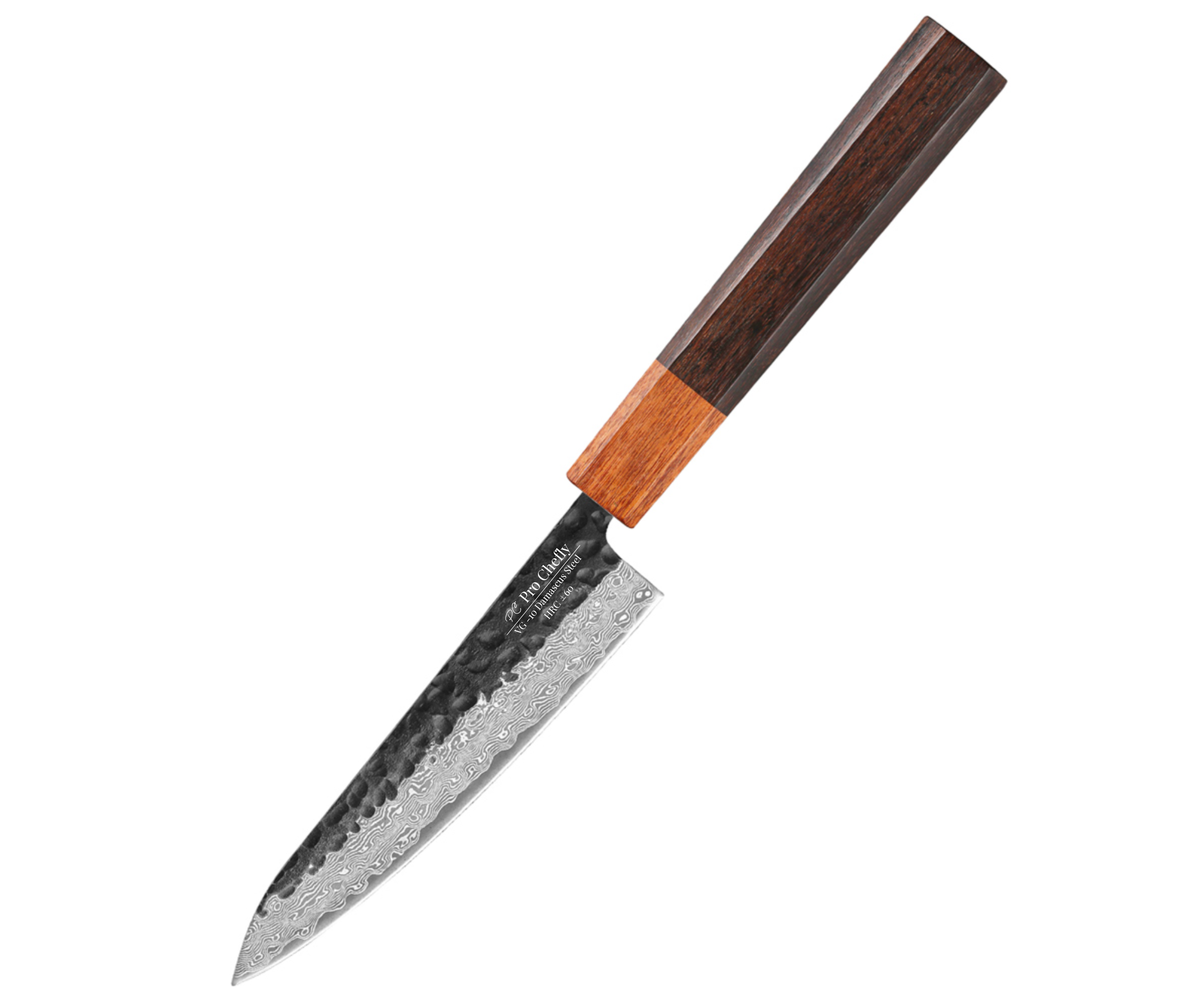
Petty knives thrive when the cutting board is involved. Their longer blade, flatter profile, and added knuckle clearance make them miniature workhorses rather than oversized paring knives. Slicing shallots, trimming green beans, portioning citrus, or cleaning proteins all favor a Petty. The extra length allows cleaner draw cuts, while the added height keeps fingers safe and controlled. As we discussed in Why Petty Knives Are a Must-Have for Professional Chefs, Petty knives excel when precision meets repetition. The 5" VG-10 Damascus Petty Knife shines here. VG-10 steel holds a fine edge for delicate cuts, yet stays stable during light board work. For cooks who prep daily, this knife becomes the quiet hero that handles most “small” jobs without feeling small itself.
When Paring Knives Take the Lead
Paring knives belong off the board. Any task that requires lifting the ingredient into your hand immediately shifts the advantage. Peeling apples, deveining shrimp, coring strawberries, or trimming silver skin are paring knife territory. The short blade gives maximum feedback, allowing micro-adjustments without leverage fighting back. We covered this in Why Paring Knives Matter for Precision Tasks, where control wasn’t about sharpness alone, but about blade length working with the hand. The 3.5" VG-10 Damascus Paring Knife excels at these moments. Its compact blade responds instantly to subtle pressure changes, making detail work safer and more accurate. This knife doesn’t want a cutting board, it wants your full attention and a steady grip.
The Board Test That Settles the Debate
Here’s the simplest rule that rarely fails. If the ingredient stays on the board, reach for a Petty. If it comes into your hand, grab a paring knife. Petty knives maintain contact with the surface, keeping cuts consistent and reducing wrist strain. Paring knives rely on wrist articulation, turning the blade into an extension of your fingers. As we noted in Petty vs Paring Knife, Which Blade Handles Precision Prep Better, the mistake most cooks make is forcing one knife into both roles. Once you stop doing that, both blades suddenly feel perfect at their jobs.
Why Steel Choice Matters Even at Small Sizes
Small knives magnify steel behavior. A soft edge rolls quickly, while brittle steel chips faster due to higher pressure concentration at the tip. VG-10 Damascus steel balances this beautifully. It sharpens finely enough for paring work while staying composed during light board contact. That balance is why both the 5" VG-10 Damascus Petty Knife and 3.5" VG-10 Damascus Paring Knife feel predictable instead of twitchy. Consistency matters more with small blades than large ones. When steel behaves calmly, confidence follows.
The Ideal Everyday Pair for Precision Prep
Most kitchens don’t need to choose between Petty and paring knives, they need both. Together, they cover nearly every small-scale task without overlap or redundancy. Use the Petty for board-based slicing, trimming, and portioning. Use the paring knife for peeling, shaping, and detail work. When paired correctly, prep feels faster without rushing and cleaner without effort. This pairing echoes what we’ve emphasized across knife education at Pro Chefly, the right tool doesn’t replace another, it protects it.
Choosing the Knife That Matches the Task, Not the Trend
Trends blur distinctions. Tasks sharpen them. Petty knives favor structure, repetition, and board contact. Paring knives favor dexterity, touch, and hand-held precision. Neither is better universally, but each is unbeatable in its lane. Once you stop asking which knife is more useful and start asking which task you’re about to do, the answer becomes obvious every time.
Knife Collections
Shop the latest in Pro Chefly Damascus Knives





Chef's Notes
Stay up to date with the latest kitchen stories and recipes

- March 25, 2026
Dear Chefs, this is one of those dishes that feels like it belongs next to the ocean, even if you’re...

- March 23, 2026
Dear Chefs, this is the kind of spring dish that wakes up your entire kitchen the moment it hits the...

- March 19, 2026
Dear Chefs, some dinners don’t whisper, they walk into the kitchen with confidence and a little swagger. Surf and Turf...

- March 17, 2026
Dear Chefs, there’s something satisfying about a dish that feels wholesome, bright, and quietly comforting all at the same time....

- March 13, 2026
Dear Chefs, there is something about cooking whole fish that feels both elegant and surprisingly simple once you understand the...

- March 11, 2026
Dear Chefs, spring cooking always pulls me toward dishes that feel light, bright, and quietly luxurious without trying too hard....
- Choosing a selection results in a full page refresh.
- Opens in a new window.